The Tashkent metro opened on 6 November 1977. It was the first metro in Central Asia [1]. Its stations are underground halls with ceramics, marble, carving, and panels. On each track wall is the station name in individual metal letters.
For one of the library's fonts, Ipak Metro, we collected all the names we could find in freely licensed photographs. We did not trace the letters from photos or copy them. The task was different: to understand which lettering styles exist in the metro, which letters survive in them, and which are missing.
Why there are so few photographs
For a long time, taking pictures in the Tashkent metro was forbidden. The metro was considered a military object and a bomb shelter. The ban was lifted only in the summer of 2018 [2]. That is why almost all the freely licensed images on Wikimedia Commons were taken in 2018–2025.
Hence the main limitation. We see the inscriptions as they are now. It is not always possible to say whether they are originals or replacements. If a station was not renamed and the name is written in Cyrillic, the inscription is most likely Soviet. If the text matches a name given after 1991, the inscription is definitely late. That the letters on the walls really were changed during renamings is confirmed by a 2012 note about the Chkalovskaya station: the name was replaced “at the entrances, and also on the track walls and the diagrams” [6].
Three Soviet styles
There is no single “metro font”. It seems the lettering for each station was drawn separately, together with its architecture. Who exactly drew the letters, we could not find. The sources name the stations' architects and artists, but no one writes about the lettering [5].
Style A — thin, wide capitals (an inscription made of capital letters only). A thin, even stroke; small serifs; wide letters; an O that is almost circular. The distance between letters is almost the width of a letter. The letter Л is drawn “house-shaped”, like the Greek Λ. Dark metal letters are mounted directly on blue ceramics. This is the Kosmonavtlar station, opened on 8 December 1984 (architects S. Sutyagin and S. Sokolov) [3][4]. The most recognizable style of the metro.
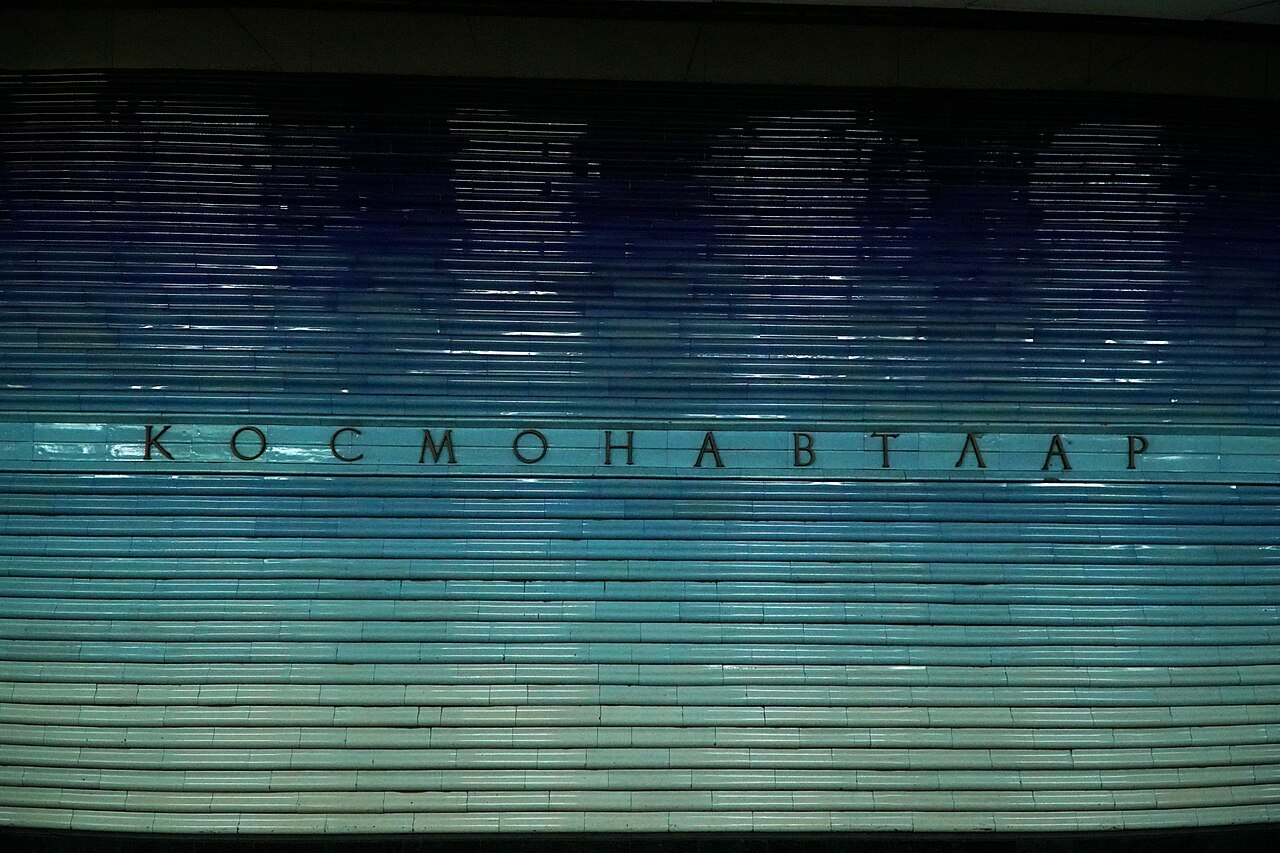
There is a riddle to this inscription. The station has carried its current name since 1 May 1992; before that it was called “Cosmonauts Avenue” [3]. So the inscription КОСМОНАВТЛАР is either new, made in the Soviet spirit, or old, with a word removed from it. The question can only be answered from 1980s photos, and we have not found any so far.
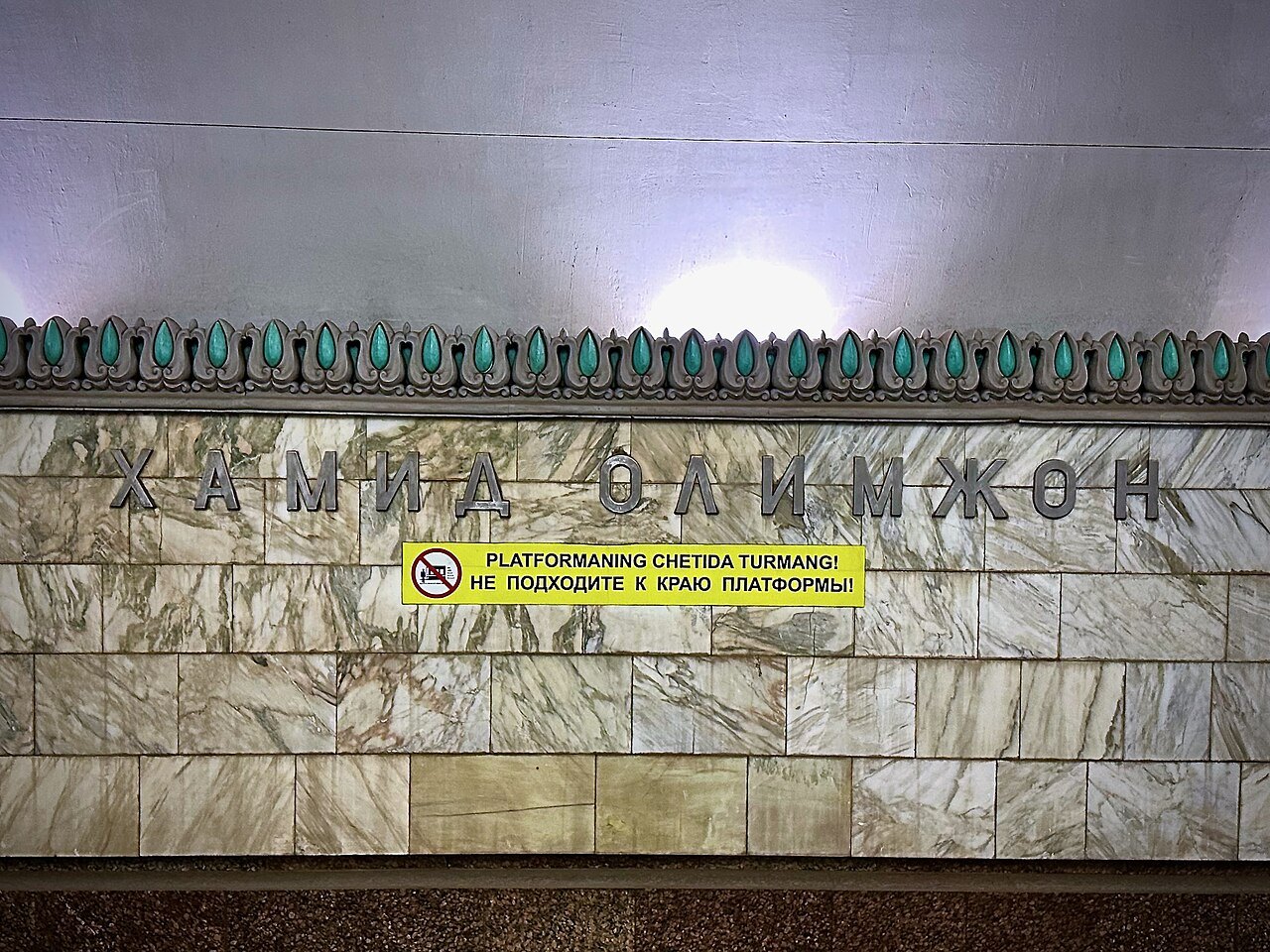
Style B — a wide grotesque of three-dimensional letters. No serifs, medium weight, wide letters with the side face of a metal profile. Generous letterspacing. This is Hamid Olimjon, a 1980 station that was never renamed.
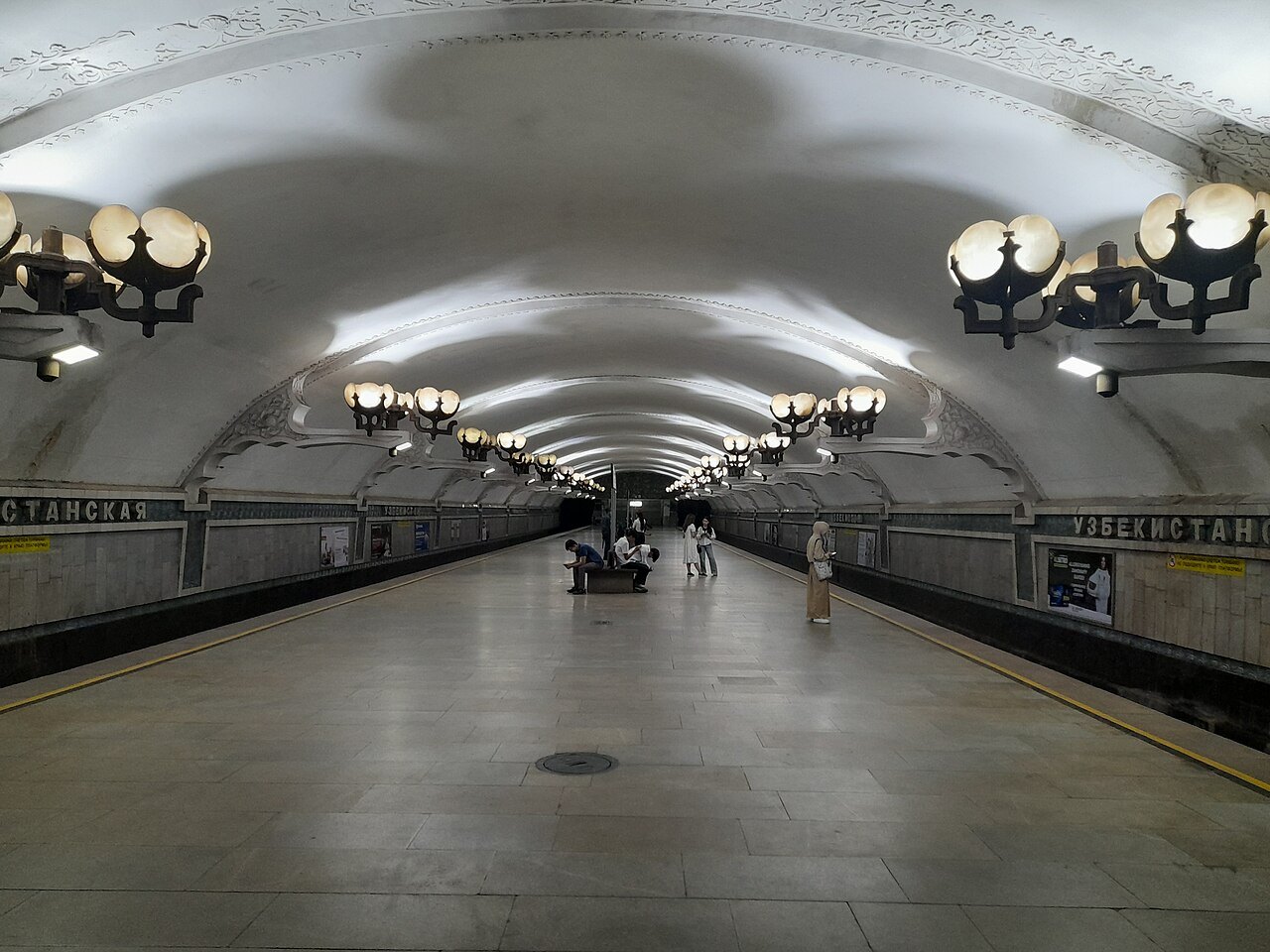
Style C — an ordinary Soviet grotesque. Cut-down letters of normal width, in light or brass metal. This is how Uzbekistanskaya (1984) and Tinchlik (1991) are lettered. In Tinchlik the Л is “house-shaped” too.
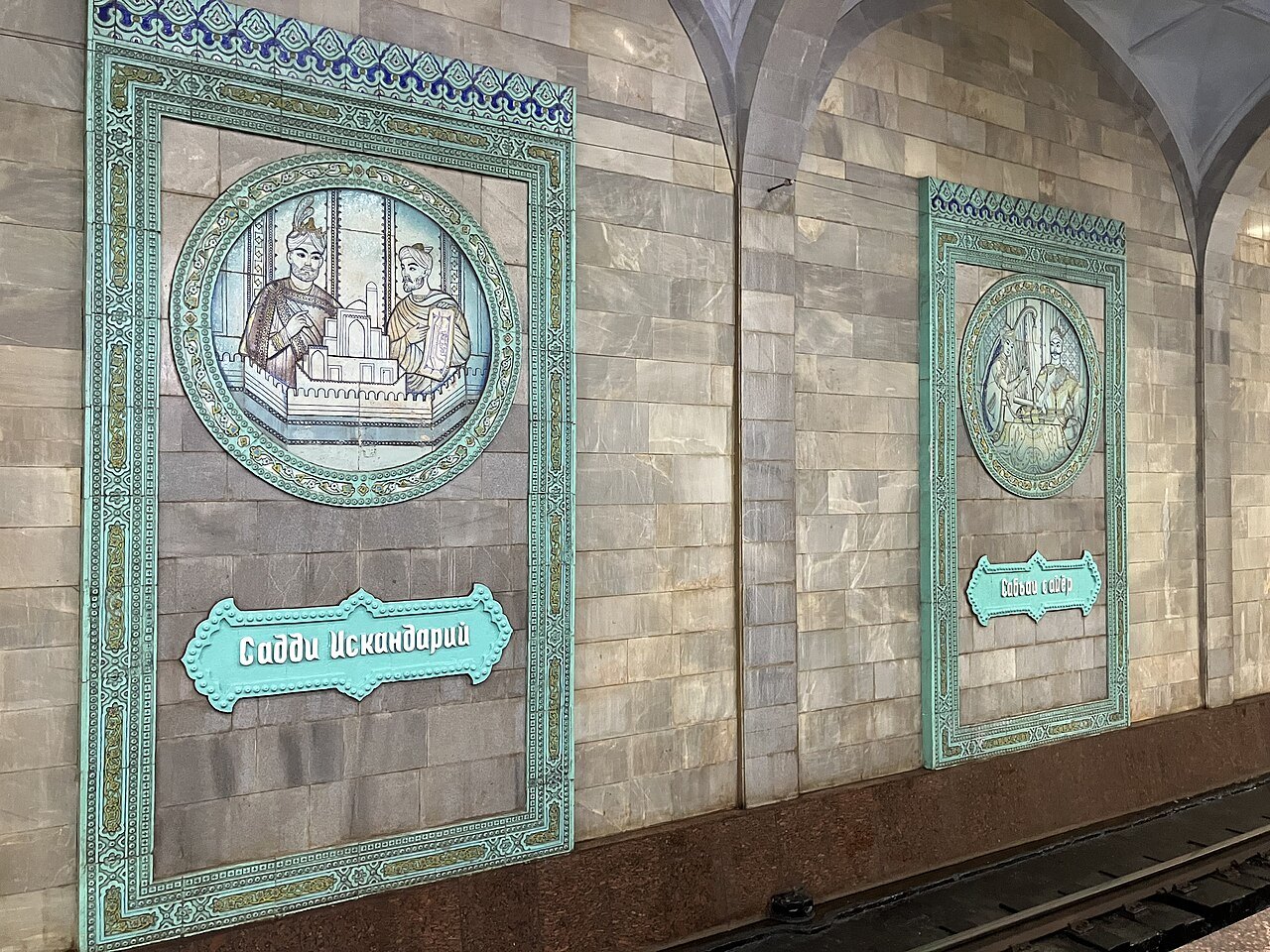
A separate case is the captions of the panels at the Alisher Navoiy station (1984). These are not the station name but decorative lowercase letters in a “calligraphy” manner on ceramic cartouches. Still, this is the only example of lowercase letters we found in the old metro.
Three styles after 1991
After the renamings, the inscriptions were made anew.
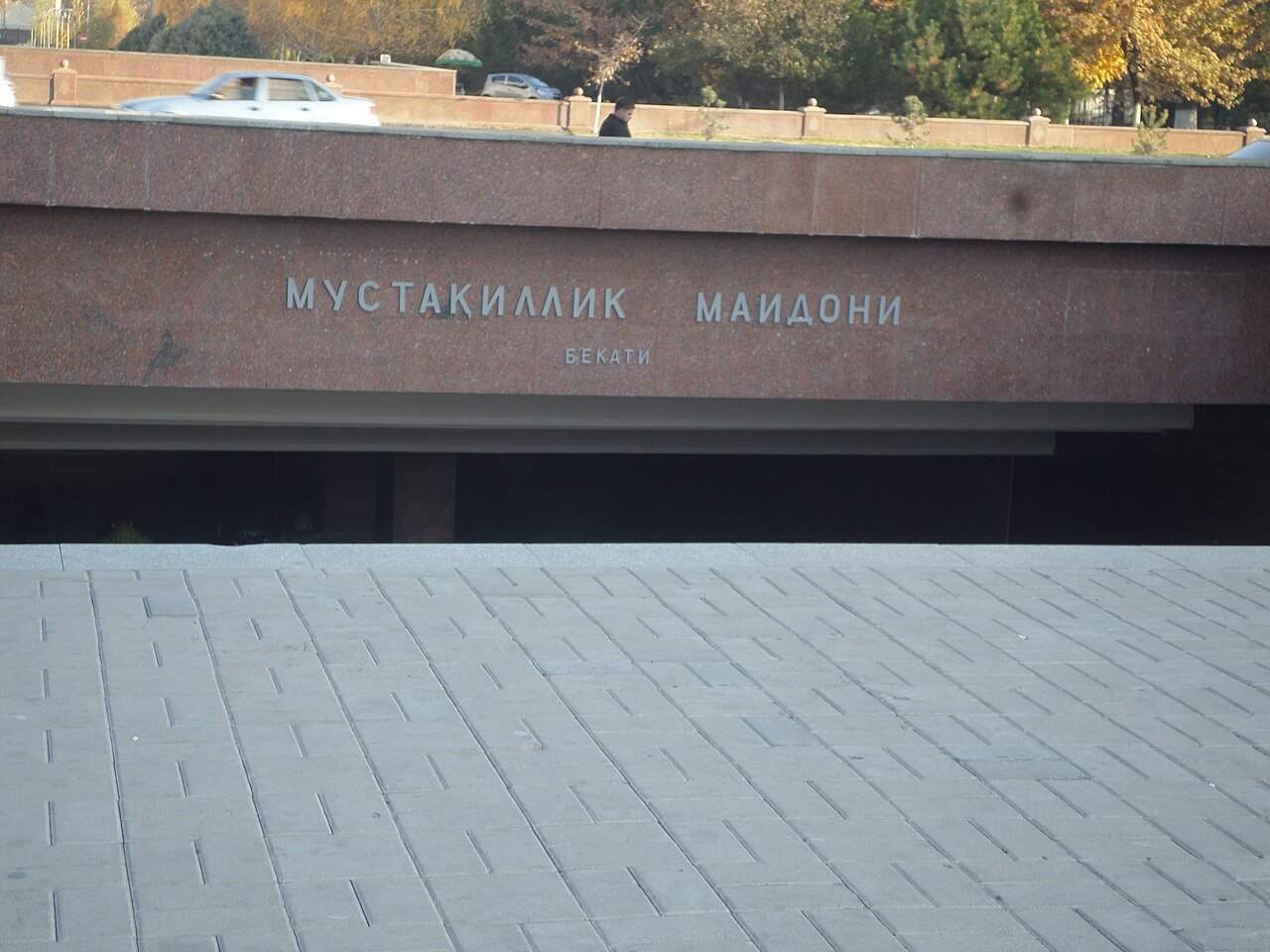
Style D — Uzbek Cyrillic of the 1990s. A grotesque of normal or narrow width, metal letters, smaller letterspacing. This is how Mustaqillik Maydoni and Amir Temur Xiyoboni are lettered. At the entrance to Mustaqillik Maydoni there already seems to be the Uzbek Қ with a tail.
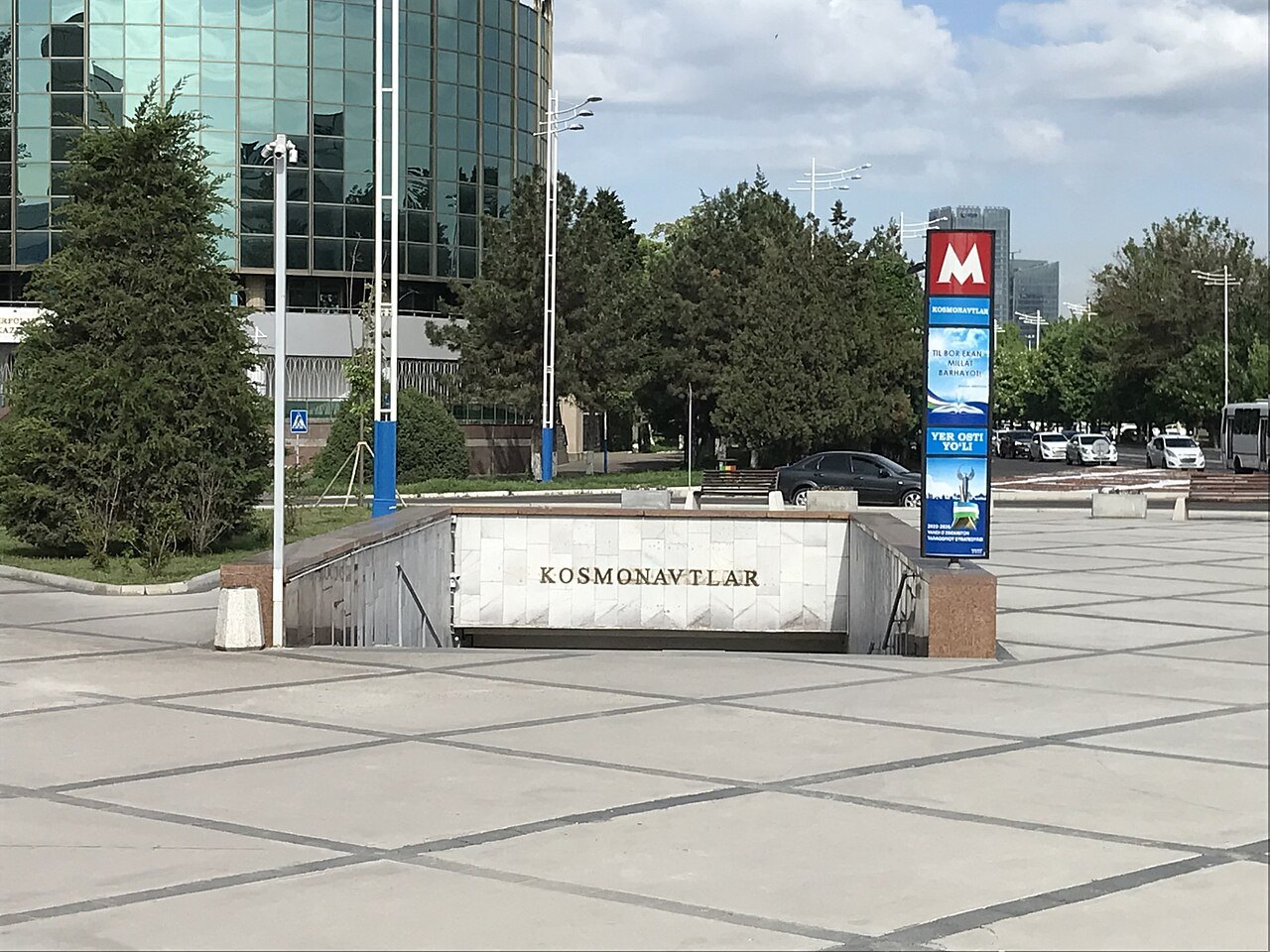
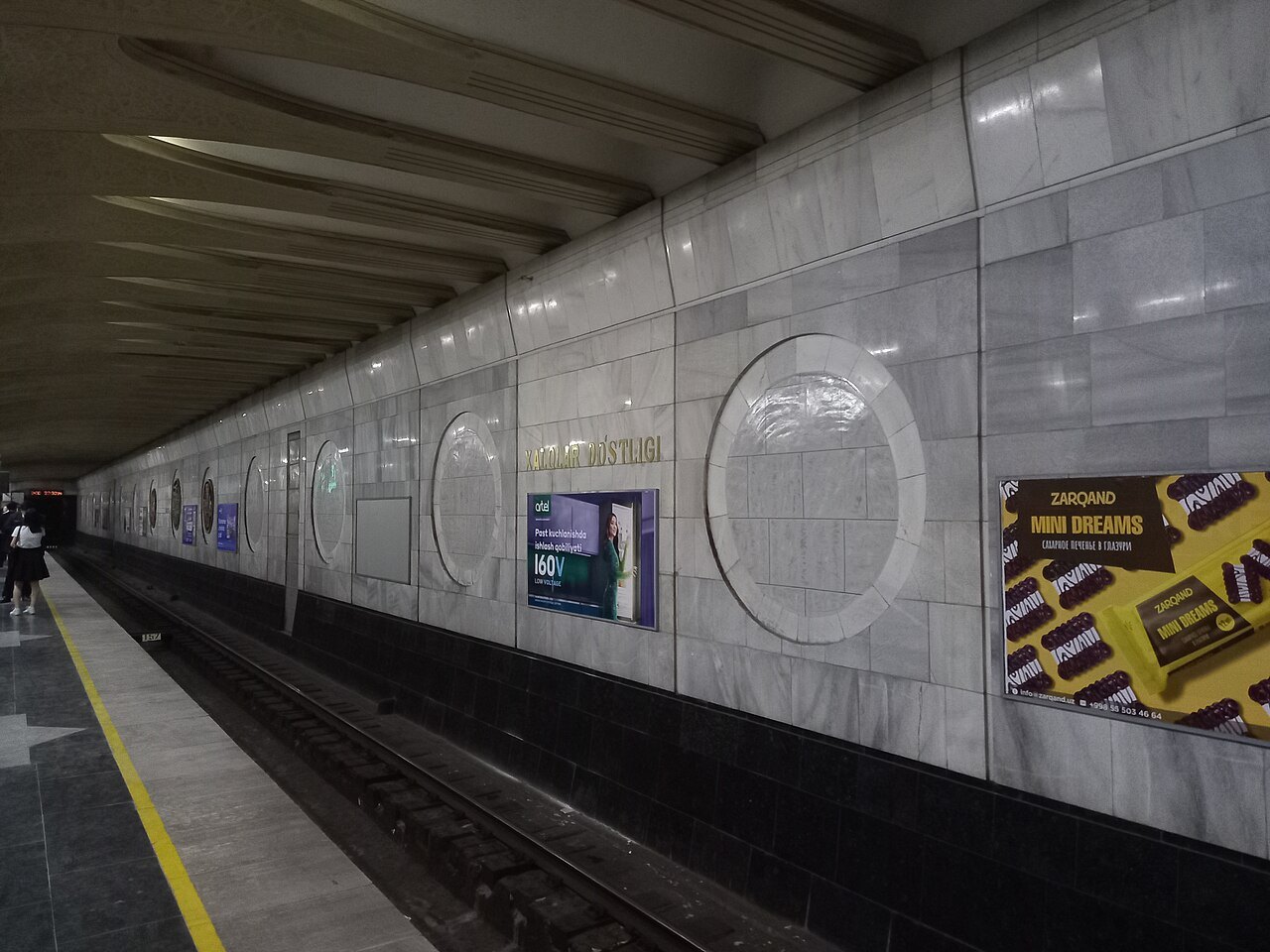
Style E — the Latin alphabet of the 2000s–2020s. These are two random fonts. At the entrances there is a serif face (a font with serifs) similar to Times: this is how “Bodomzor” and the street-level “Kosmonavtlar” entrance are lettered. On the track walls there is a narrow bold grotesque, as at “Xalqlar Doʻstligi”. They have no connection with the old inscriptions. The Kosmonavtlar station is lettered inside and outside in two different fonts in two scripts.
At “Xalqlar Doʻstligi” a straight apostrophe stands in place of the ʻ sign. With letterspacing, such a sign reads as a separate character, not as part of the letter O.
What the old inscriptions lack
All the Soviet names are written in capitals only, in Cyrillic only, in Russian or Uzbek. We collected the letters visible in the photos:
- style A: К О С М Н А В Т Л Р — 10 letters in all;
- style B: Х А М И Д О Л Ж Н — 9 letters;
- style C: У З Б Е К И С Т А Н Я Ч Л — 13 letters.
The Uzbek letters Ў, Қ, Ғ, Ҳ are absent from every Soviet sample. In “ХАМИД” there is the Russian Х, not Ҳ. Many Russian letters are missing too: Г, Ё, Й, Ф, Ц, Ш, Щ, Ъ, Ы, Ь, Э, Ю, П.
With Latin it is harder still. Some letters can be derived from Cyrillic letters of the same shape: A, B, C, E, H, K, M, O, P, T, X. Some can be assembled from parts: N from a mirrored И, V from an upside-down “house-shaped” Л. But D, F, G, J, Q, S, U, Z; the signs Oʻ and Gʻ; the ʻ and ʼ themselves; and all the lowercase letters have no sample. We had to draw those ourselves.
What this means for the font
Ipak Metro continues style A — the thin, wide capitals of Kosmonavtlar. This is the metro's most recognizable style, and together with the station it has already become world heritage.
We are not reconstructing the inscription of a particular station. The font is drawn anew from a verbal description of the style: a thin stroke, wide rounded shapes, small serifs, a “house-shaped” Л. The letters were not traced from photos. For questions about rights, write to avenex@xronocode.com.
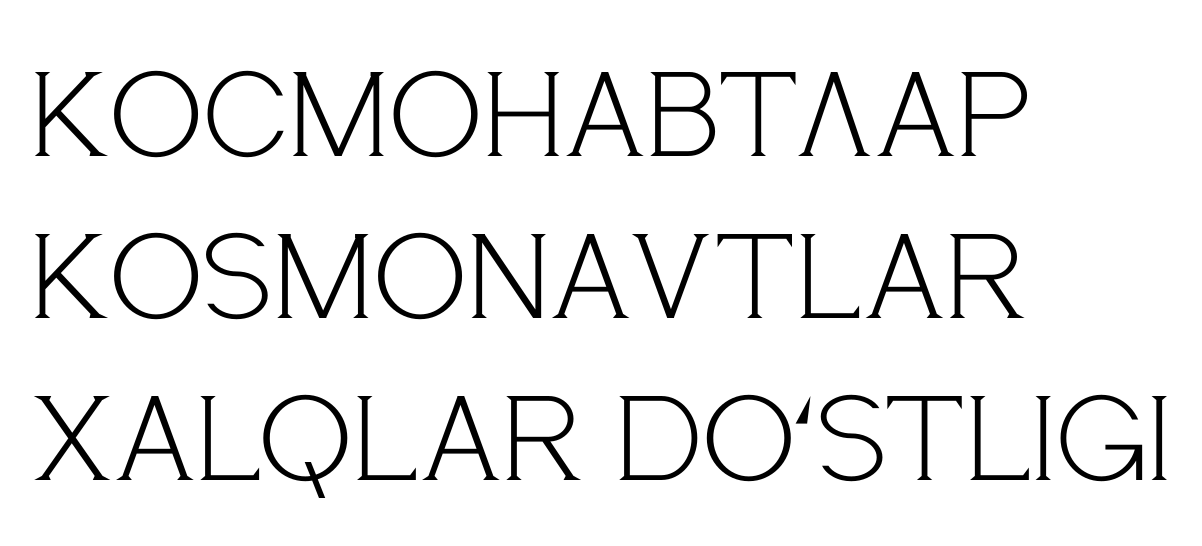
The main thing Ipak Metro gives is one name in two scripts in one style. Cyrillic and Latin are now one family. The font has Ў, Қ, Ғ, Ҳ, which the Soviet inscriptions lacked; the ʻ and ʼ signs; and the letters of the 2026 law — Ö, Ğ, Ş, Ç. The ʻ sign stands next to its O instead of hanging separately, like the straight apostrophe at “Xalqlar Doʻstligi”.
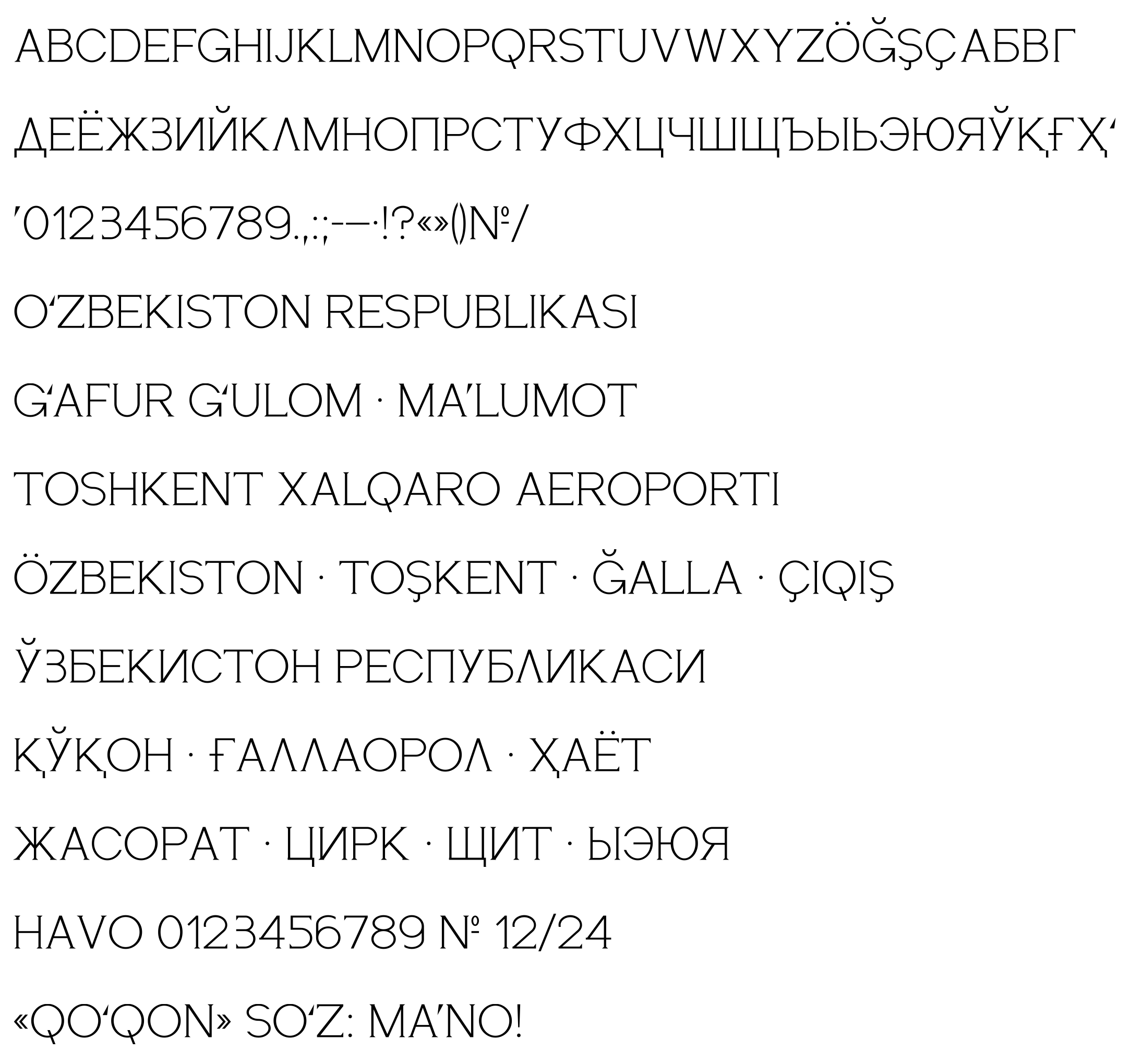
What remains to be done: to photograph all the Soviet inscriptions in the metro — this has been allowed since 2018. First of all Pakhtakor, Chorsu, Gʻafur Gʻulom, Oybek, and Tashkent. And to find 1980s photos, to understand whether the КОСМОНАВТЛАР inscription is original.
Sources
- Wikipedia: Tashkent Metro. https://en.wikipedia.org/wiki/Tashkent_Metro
- RFE/RL, 2018. https://www.rferl.org/a/uzbekistan-s-secret-underground-a-ban-on-photography-is-lifted-on-tashkent-metro-/29437456.html
- Википедия: Космонавтлар. https://ru.wikipedia.org/wiki/Космонавтлар
- Wikipedia: Kosmonavtlar (Tashkent Metro). https://en.wikipedia.org/wiki/Kosmonavtlar_(Tashkent_Metro)
- Hook.report, 12.2022. https://hook.report/2022/12/ne-transport-a-muzey-kakoy-to/
- Podrobno.uz, 11.10.2012. https://podrobno.uz/cat/obchestvo/v-tashkente-pereimenovali-stanciu-metro-chkalova/
- Wikipedia: Xalqlar Doʻstligi (Tashkent Metro). https://en.wikipedia.org/wiki/Xalqlar_Doʻstligi_(Tashkent_Metro)
- Gazeta.uz, 07.08.2024. https://gazeta.uz/en/2024/08/07/tashkent-metro-navigation
- Euronews, 02.08.2026. https://www.euronews.com/2026/08/02/grand-designs-tashkents-modernist-architecture-joins-unesco-world-heritage-list
- Wikipedia: Kosmonavtlar (Tashkent Metro). https://en.wikipedia.org/wiki/Kosmonavtlar_(Tashkent_Metro)
- Wikipedia: Xalqlar Doʻstligi (Tashkent Metro). https://en.wikipedia.org/wiki/Xalqlar_Doʻstligi_(Tashkent_Metro)
- Wikimedia Commons: КОСМОНАВТЛАР on the track wall (Adam Harangozó, CC BY-SA 4.0). https://commons.wikimedia.org/wiki/File:Kosmonavtlar_Station_of_Tashkent_Metro_6.jpg
- Wikimedia Commons: ХАМИД ОЛИМЖОН (Прикли, CC BY 4.0). https://commons.wikimedia.org/wiki/File:Hamid_Olimjon_Station_Plate.jpg
- Wikimedia Commons: УЗБЕКИСТАНСКАЯ (ShNajimova, CC BY 4.0). https://commons.wikimedia.org/wiki/File:O‘zbekiston_metro_bekati.jpg
- Wikimedia Commons: entrance to Mustaqillik Maydoni (Bobyrr, CC BY-SA 4.0). https://commons.wikimedia.org/wiki/File:Entrance_station_Mustaqilliq_Maidoni.JPG
- Wikimedia Commons: XALQLAR DOʻSTLIGI (Jamshid Nurkulov, CC BY-SA 4.0). https://commons.wikimedia.org/wiki/File:Xalqlar_do‘stligi_metro_bekati_01.jpg
- Wikimedia Commons: the street-level Kosmonavtlar entrance (Virtual trip, CC BY 4.0). https://commons.wikimedia.org/wiki/File:タシュケント地下鉄_コスモナフトラル駅の出入口.jpg
- Wikimedia Commons: panels of the Alisher Navoiy station (Schokifaktor, CC BY-SA 4.0). https://commons.wikimedia.org/wiki/File:Metrostation_Alisher_Navoiy_in_Taschkent_1.jpg


The style descriptions are made from photographs, without measurements. The station opening dates follow the Russian Wikipedia articles about the stations.