Take the word for “Uzbekistan” in the native language. A person born in Tashkent in 1920 could see it written four ways over a lifetime: in Arabic letters, in the Yanalif Latin alphabet, in Cyrillic, and in the Latin alphabet of independent Uzbekistan. Their grandchildren will see a fifth — the Latin alphabet of the 2026 law.
For a type designer this is not just history. Each change of alphabet has left its own layer of inscriptions on the streets. Old signs are not taken down in a day. That is why a font for Uzbekistan must be able to set several standards at once. This article is a short guide to them.
Arabic script: until the 1920s
For many centuries, Uzbek and the related Turkic languages of Central Asia were written in Arabic script [1]. The inscriptions on the monuments of Samarkand and Bukhara are made in the same script, although the language of those inscriptions is more often Arabic or Persian, not Uzbek.
Arabic script had a well-known difficulty for Uzbek. It conveys consonants well and vowels poorly. But Uzbek has many vowels, and they matter for meaning. In the early 1920s the Jadid reformers proposed a new orthography in which vowels are written explicitly. According to English Wikipedia, it was adopted in 1921 [1]. According to the Russian one, the 1921 project was never carried out, and the reformed alphabet was officially approved on 18 October 1923 [2]. The sources disagree here, so we give both dates.
Yanalif: the Latin alphabet of the 1920s–1930s
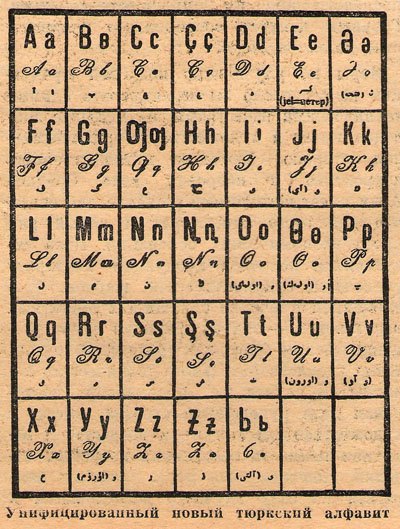
In 1926 the First Turkological Congress in Baku approved the move of the USSR's Turkic languages to the Latin alphabet. The new alphabet was called Yanalif — “new alphabet” [1][3]. The Uzbek SSR switched to it in the late 1920s. The Uzbek version of 34 characters was approved in May 1929 at a conference in Samarkand [1][2]. Sometimes 1928 is named as the year of the switch; we have not found a document with that date.
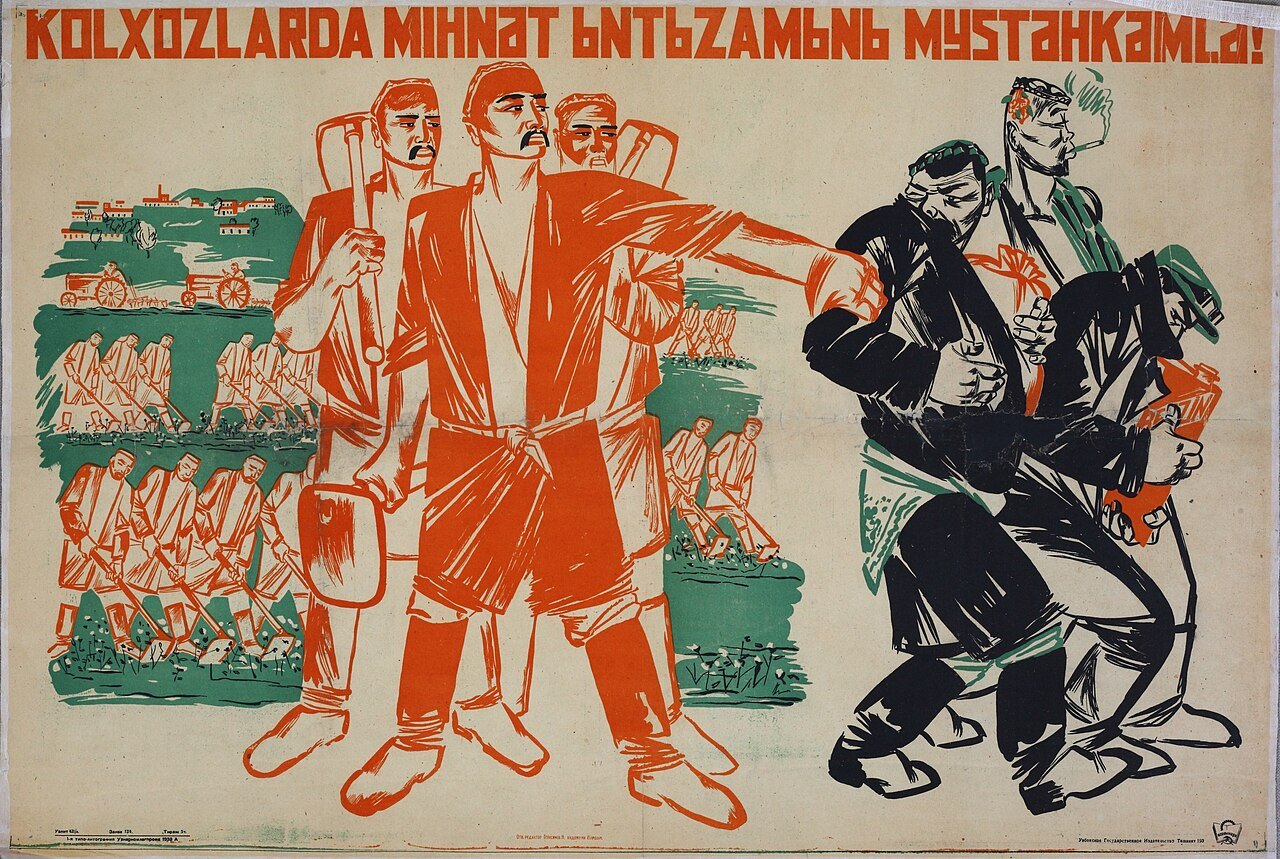
The 1933 poster shows what this Latin alphabet looked like. It had letters that are not in the modern Uzbek Latin alphabet: Ь, Ꞑ, Ƣ, Ə.
Yanalif did not live long. In 1937 a group led by A. K. Borovkov began preparing a new edition, but the switch to Cyrillic overtook it [1][2].
Cyrillic: from 1940
In 1939 a commission under the People's Commissariat for Education of the Uzbek SSR prepared a draft alphabet based on Cyrillic. On 8 May 1940 a session of the republic's Supreme Soviet passed a law on the new alphabet. The deadline for the switch was 1 January 1942 [2].
Uzbek Cyrillic took the Russian alphabet and added four letters: Ў, Қ, Ғ, Ҳ [1]. These are the letters still visible on signs, in old books, and in the metro. A font that cannot set them cannot set half of the country's historical inscriptions.
The Latin alphabet of independent Uzbekistan: 1993 and 1995
On 2 September 1993, law No. 931-XII, “On introducing the Uzbek alphabet based on Latin script”, was signed [5]. The first version of the alphabet contained letters with diacritics — extra marks above or below the letter: Ç, Ş, Ğ, Ö, Ñ [1][2].
Already on 6 May 1995 the law was amended. The letters with diacritics were replaced: Ç with Ch, Ş with Sh, Ğ with Gʻ, Ö with Oʻ, Ñ with Ng [2]. This Latin alphabet has been in use for about thirty years. It has 26 letters and three letter combinations [1].
The transition dragged out. The deadline for the full move to Latin was postponed several times: first from 2000 to 2005, then further; the sources give various intermediate dates, and the last deadline was 1 January 2023 [2]. In the meantime, Cyrillic did not go away. It stayed in newspapers, on signs, and in the habit of the older generations.
The ʻ sign in the letters Oʻ and Gʻ is a story of its own. How to encode it and what it should look like is covered in the article “The ʻ sign: what the law says and what Unicode says”.
The 2026 law
On 7 July 2026 the Legislative Chamber passed a law changing the alphabet [6]. On 10 September the Senate approved it [7]. Under the law, Oʻ becomes Ö, Gʻ becomes Ğ, Sh becomes Ş, and Ch becomes Ç. The combination Ng is no longer counted as a separate letter. The ʼ sign (tutuq belgisi, the tutuq sign) remains [7].
As of 19 October 2026, we could not find the president's signature on the law in open sources. So we write carefully: the law has been passed by parliament but, as far as we know, has not yet been signed.
The result is a curious loop. The letter Ş is appearing in the Uzbek Latin alphabet for the third time: in Yanalif, in 1993, and now. Ç in the meaning of “ch” — for the second time, after 1993–1995 [1][2].
What this means for the font
Today on a single Tashkent street you can see Soviet Cyrillic, the 1995 Latin alphabet with ʻ, and soon the Latin alphabet with Ö and Ğ. None of these standards will disappear in a year. A sign hung today may hang for ten years and outlive a change of alphabet.
That is why Ipak is built for all the current standards at once.
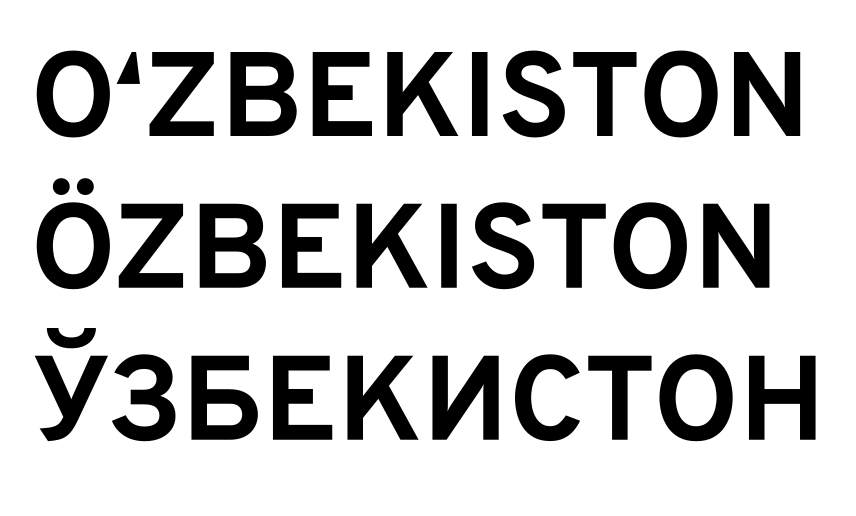
Ipak Davlat and the library's accent fonts include the 1995 Latin alphabet with the ʻ and ʼ signs, the letters of the 2026 law (Ö, Ğ, Ş, Ç), and Cyrillic, both Russian and Uzbek (Ў, Қ, Ғ, Ҳ). If the alphabet changes, a sign will not have to be redrawn in a different font. Only the letters that changed are reset; the look stays the same.
What Ipak does not have, we will say plainly. There is no Arabic script in the fonts. The special Yanalif letters, such as Ƣ and Ꞑ, are not there either. For museum and historical inscriptions of the 1930s this is a gap, and we note it as a possible task for the future.
Sources
- Wikipedia: Uzbek alphabet. https://en.wikipedia.org/wiki/Uzbek_alphabet
- Википедия: Узбекская письменность. https://ru.wikipedia.org/wiki/Узбекская_письменность
- Wikipedia: Yañalif. https://en.wikipedia.org/wiki/Yañalif
- type.today: Uzbek. А. Шайдуллина, 04.12.2023. https://type.today/en/journal/uzbek
- Закон РУз № 931-XII от 02.09.1993 (lex.uz). https://lex.uz/docs/112283
- Kun.uz, 07.07.2026. https://kun.uz/en/news/2026/07/07/parliaments-lower-house-passes-bill-to-revise-uzbek-alphabet-848eb2
- gov.uz, 10.09.2026. https://gov.uz/en/kongeotexnazorat/news/view/217317
- Wikimedia Commons: 1933 poster, Yanalif (unknown author, Public domain). https://commons.wikimedia.org/wiki/File:“Strengthen_working_discipline_in_collective_farms”_–_Uzbek,_Tashkent,_1933_(Mardjani).jpg
- Wikimedia Commons: “Unified New Turkic Alphabet” table (unknown author, Public domain). https://commons.wikimedia.org/wiki/File:Alfavit2.jpg

