In the 1995 Uzbek Latin alphabet there are two letters written with a small sign at the top right: Oʻ and Gʻ. The sign looks like an inverted comma or the digit “6”. Next to it lives its “brother” ʼ, which looks like a “9”. That is the tutuq sign (tutuq belgisi), a separator sign: maʼlumot, sanʼat.
The sign is small, but it is exactly where most fonts and signs break. When we started drawing our own version, the first question was: what shape is it supposed to be? Is there a standard? We read the law, the orthography rules, the Unicode standard, and the international transliteration table. The answer turned out to be unexpected.
What the law says
The Uzbek Latin alphabet was introduced by law No. 931-XII of 2 September 1993. In its current form the alphabet is set by the amendments of 6 May 1995 [1]. The law contains a table of letters. It lists Oʻ and Gʻ, and at the end of the table the sign itself is given, called an apostrophe.
An interesting detail: in the Russian text of the law on the official portal lex.uz these letters are printed with a backtick — “O`o`”, “G`g`” — and the sign itself is shown as “(`)” with an explanation that it is an apostrophe [1]. That is the typewriter character U+0060, which should not be in the Uzbek alphabet. Of course, this is a quirk of the electronic copy, not a decision of the legislator. But it shows the main point well: the law lists the sign and says what it is for, but does not describe its shape.
The orthography rules were approved by Cabinet of Ministers resolution No. 339 of 24 August 1995 [2]. They state in detail which sound the letter Oʻ conveys (rule 5) and the letter Gʻ (rule 28). Rule 32 is devoted to the ʼ sign: it marks a long vowel in borrowed words (aʼlo, baʼzan) and separates a vowel from the preceding consonant (inʼom, sanʼat). Two more rules concern the same sign: under rule 17, ʼ is placed between s and h when they convey two separate sounds rather than the sound “sh” (Isʼhoq, asʼhob); under rule 75, when a word is broken across lines, the sign stays on the first line (maʼ-rifat, inʼ-om). In the electronic text of the rules on lex.uz the “correct” characters U+02BB and U+02BC are used. But here too there is not a word about how the sign should look: its slant, size, thickness, or where it sits in height.
What Unicode says
Unicode is an international table in which every character has a number and a name. Two characters matter for Uzbek [3]:
- U+02BB MODIFIER LETTER TURNED COMMA — “modifier letter: turned comma”. This is the ʻ in Oʻ and Gʻ.
- U+02BC MODIFIER LETTER APOSTROPHE — “modifier letter: apostrophe”. This is ʼ, the tutuq sign (tutuq belgisi).
The word “modifier” matters here. For Unicode this is a letter, not a punctuation mark. Programs treat it as part of the word. The quotation marks ‘ and ’ (U+2018, U+2019) are different characters: those are punctuation marks. The straight apostrophe ' (U+0027) is a typewriter character.
The very name “turned comma” suggests the “6” shape. The examples in the Unicode reference are the Hawaiian ʻokina and the Tongan fakauʻa [3]. Uzbek is not mentioned there. This shows once more: Unicode gives the character a number and a name, but it does not draw it for the designer. The familiar image of the “six” comes from the character's name, not from the Uzbek law.

What happens in practice
The correct sign is not in standard keyboard layouts. Among the built-in Windows layouts for Uzbek there is only the Cyrillic one (Uzbek Cyrillic); there is no Uzbek Latin one, and there is no built-in way to type ʻ (U+02BB) [11]. In Word the sign can be produced like this: type 02BB and press Alt+X. So people type what is at hand: a straight apostrophe or a quotation mark [7][8].
The Kun.uz journalist Shuhrat Shokirjonov wrote about this in 2023: “Bitta so‘zni 13 xil yozish mumkinligiga guvoh bo‘lasiz va ulardan faqat bittasi to‘g‘ri” — “you will see that one word can be written in 13 ways, and only one of them is correct” [9].
We checked this on the open map (our own measurement, 18 October 2026: an OpenStreetMap query through the Overpass API service counted objects within the boundaries of Tashkent by their Uzbek name). About 4600 objects turned up whose Uzbek name has one of the similar signs after an O or G. The straight apostrophe stood in about 88% of the cases, the correct ʻ in about 7%.
A type designer's advice
The only practical recommendation we found from professionals is in the type.today article about Uzbek writing (2023). There the sign is described as an inverted single quotation mark that, in some fonts, differs from the quotation mark in size. The main advice is not to make the distance between the O or G and the sign too large, otherwise holes appear in the setting [6].
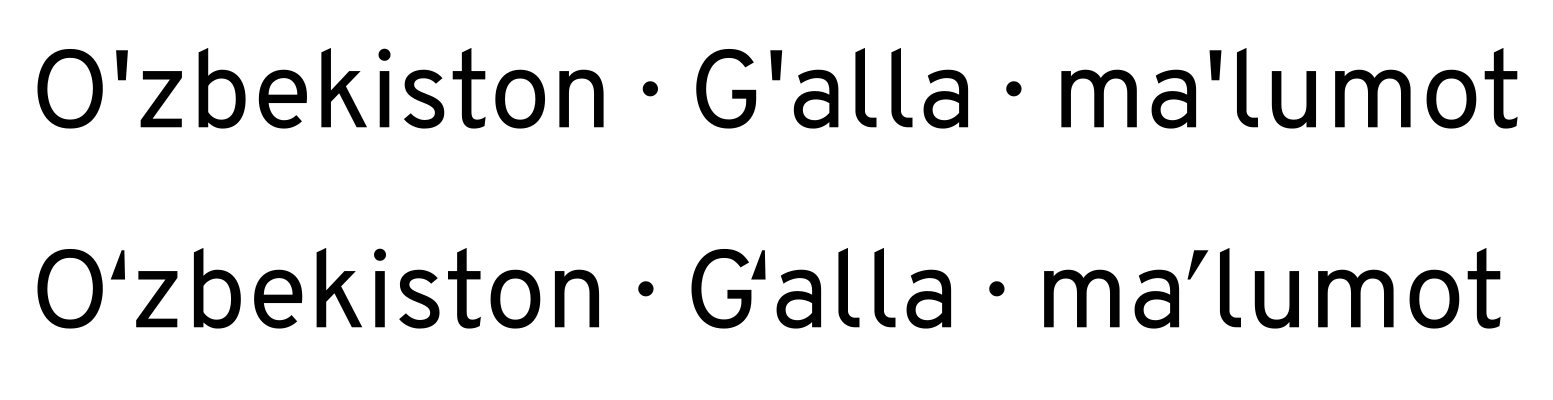
We saw this for ourselves. Our own measurement (October 2026): ten popular open fonts from Google Fonts, the character tables read with fontTools, the test line set with HarfBuzz. Of the ten, four have no ʻ sign at all. In IBM Plex Sans the sign is 2–3 times wider than needed, and the word falls apart: “O ʻ zbekiston”. Only one font, Montserrat, nudges the sign a little closer to the O and G. Not one draws the ʻ as part of the letter.
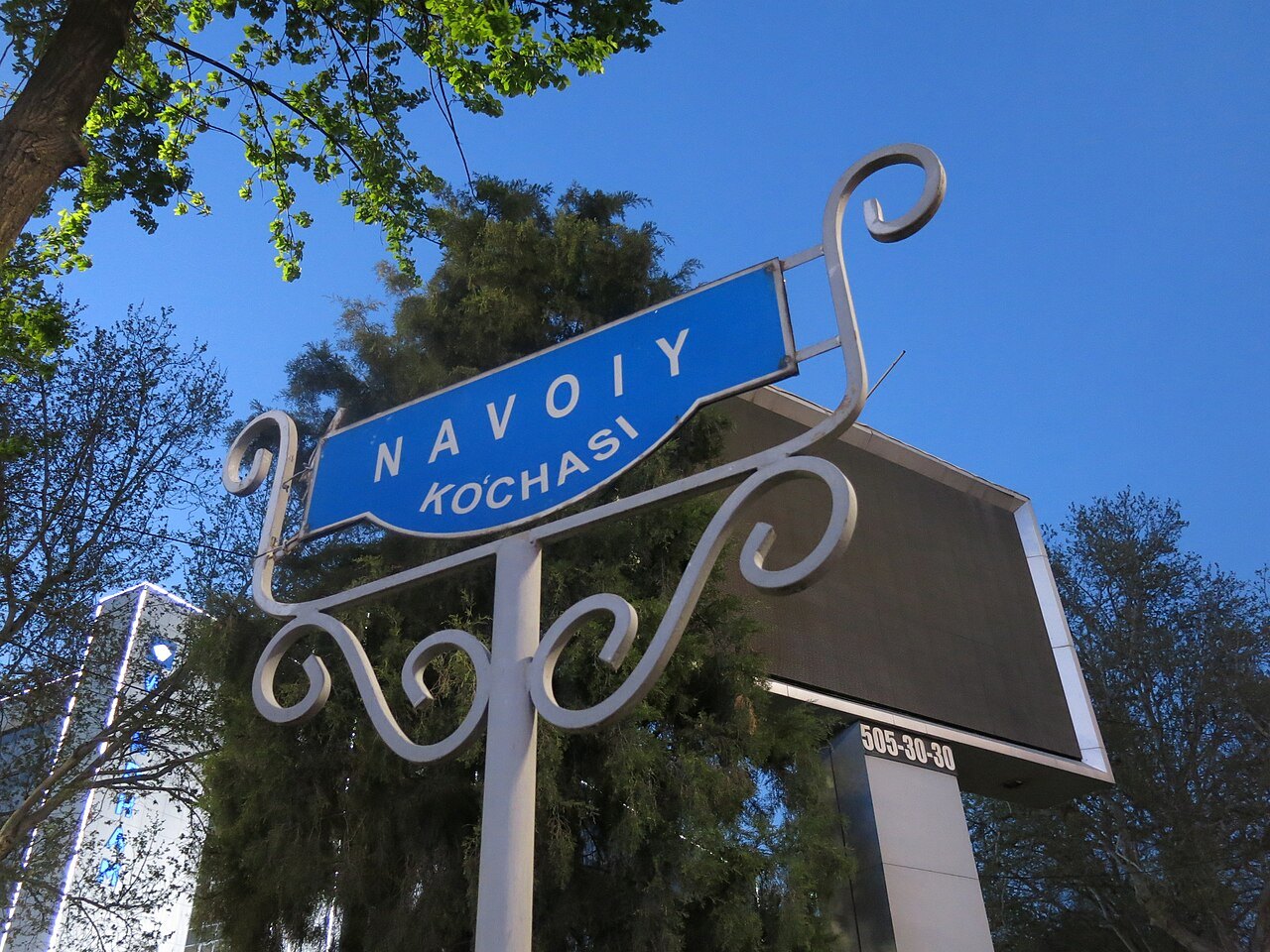
On the streets the shape of the sign is usually right; the trouble is elsewhere: it is small and sits tightly.
What this means for the font
Since the law does not set the shape, we are free to invent it. And we must make the sign work.
In Ipak Davlat the ʻ and ʼ signs are drawn anew. The round “teardrop” of the quotation mark that the base font had did not fit the straight cuts of our letters. Now it is a wedge with straight cuts. The heavy end is one and a half times the stroke thickness; the light end is almost pointed. The ʻ has its mass at the bottom and a 10° slant; the ʼ has its mass at the top and a 23° slant. The two signs cannot be confused even from a distance.
The ʻ sign sits close to the O and G, as part of the letter. The next letter steps back to the usual distance. For details of how we aligned this, see the article “The mark band: aligning Oʻ and Gʻ”.
And since people type the straight apostrophe anyway, the font helps them itself. For Uzbek text a substitution is enabled: inside a word, after O and G, the typed ' turns into ʻ; between letters it turns into ʼ. The English word King's the font leaves alone.
In the library's accent fonts — Bannai, Ganch, Metro, Kalam — the sign is drawn in the logic of each style rather than taken ready-made from the quotation marks. This is possible precisely because the shape of the sign is a designer's decision, not a requirement of the law.
Sources
- Закон РУз № 931-XII от 02.09.1993, в редакции Закона от 06.05.1995; русский текст на lex.uz. https://lex.uz/docs/112283
- Постановление КМ РУз № 339 от 24.08.1995 «Об утверждении основных правил орфографии узбекского языка». https://lex.uz/docs/1625271
- Unicode Character Database, NamesList.txt. https://www.unicode.org/Public/UNIDATA/NamesList.txt
- BGN/PCGN 2000 Agreement, Uzbek: Table of Correspondences (verified as current in November 2017). https://geonames.nga.mil/geonames/GNSSearch/GNSDocs/romanization/TABLE_OF_CORRESPONDENCES_FOR_UZBEK.pdf
- GOV.UK: Romanization systems. https://www.gov.uk/government/publications/romanization-systems
- type.today: Uzbek. А. Шайдуллина, 04.12.2023. https://type.today/en/journal/uzbek
- Wikipedia: Gʻ. https://en.wikipedia.org/wiki/Gʻ
- Wikipedia: Uzbek alphabet. https://en.wikipedia.org/wiki/Uzbek_alphabet
- Kun.uz, 27.09.2023. https://kun.uz/news/2023/09/27/lotin-yozuvini-takomillashtirish-muammoli-4-ta-harf-nega-ozgartirilmoqda
- Wikimedia Commons: NAVOIY KOʻCHASI street sign (Enric, CC BY 4.0). https://commons.wikimedia.org/wiki/File:184_Navoiy_Shoh_Ko'chasi_(Taixkent),_rètol.jpg
- Microsoft: Keyboard identifiers and input method editors for Windows. https://learn.microsoft.com/en-us/windows-hardware/manufacture/desktop/windows-language-pack-default-values

The OpenStreetMap measurement is our own (Overpass API — a service for querying map data, not to be confused with the Overpass font; 18.10.2026; data © OpenStreetMap contributors, ODbL). The check of the ten open fonts is our own (Google Fonts files, 18.10.2026; fontTools and HarfBuzz).